The Basics
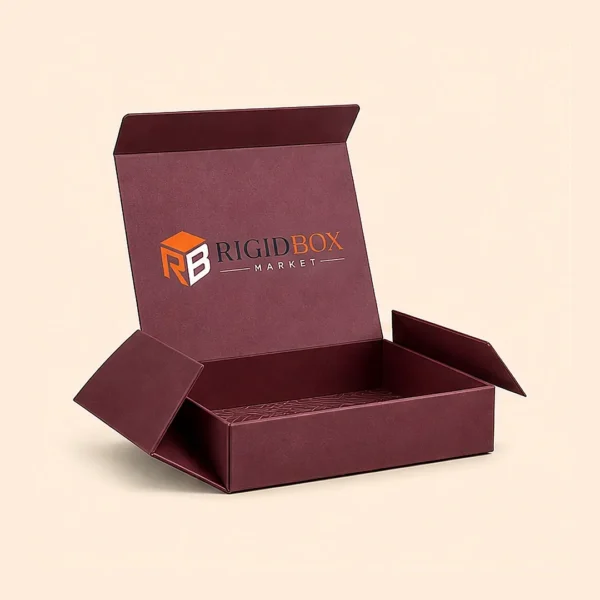
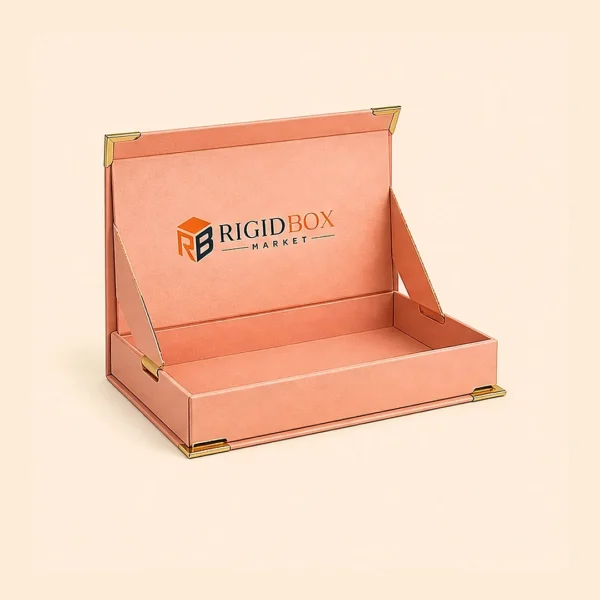
A collapsible rigid box is built to do something most rigid formats can’t: fold flat. Score lines and reinforced corner joints let the box break down into a slim, stackable panel for storage and freight, then pop back into a fully rigid shape when it’s needed on the packing line. It’s a format built around a practical problem — standard rigid boxes ship and store as finished, three-dimensional shapes, which eats warehouse space and freight capacity fast once volume climbs. A pallet of folded collapsible blanks can hold several times the number of units as the same pallet loaded with pre-assembled boxes, which is the entire economic case for the format.
Material & Fold-Line Engineering
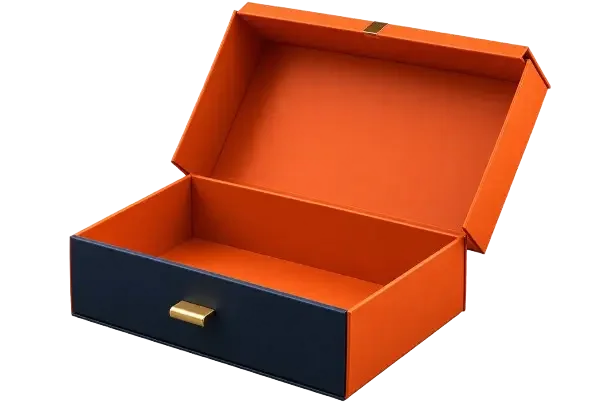
The box uses the same rigid chipboard core as a standard rigid box, but the corners are built with a locking mechanism — typically a folded tab-and-slot joint or a magnetic corner catch — rather than a glued, permanently fixed seam. Getting this right is a precision job: the fold lines have to be scored deep enough to fold cleanly but not so deep that they weaken the board and let the corner sag once assembled. A well-built collapsible box locks into a shape just as rigid as a fixed-corner box once it’s erected, which is the entire point of the format; a poorly built one feels wobbly at the seams no matter how good the print looks. The locking joint typically needs to be engaged from more than one angle to fully seat, which is a small learning curve for packing staff but becomes second nature after the first few units. Wall thickness generally sits in the same 1.5mm to 3mm range used across rigid formats, chosen against the weight of what the box will carry once it’s folded up for use.
Customization Options
Because the box is essentially a flat blank until it’s assembled, printing and finishing are applied before the fold lines are scored, which means the full range of standard treatments — foil stamping, embossing, debossing, spot UV, and matte, gloss, or soft touch lamination — are all available exactly as they would be on a fixed-corner box. Corner locking hardware can be built as a hidden magnetic catch for a cleaner exterior look, or as a visible tab-and-slot detail that becomes part of the design itself, and some brands intentionally expose the fold lines as a design feature rather than disguising them, treating the box’s collapsibility as part of its story rather than something to hide. Interior inserts are usually added after assembly, so foam, paperboard platforms, or fabric-wrapped trays can still be built to fit the product precisely, and depth or footprint can be adjusted independently of the folding mechanism.
- Locking corner joints, hidden magnetic or visible tab-and-slot styles
- Full custom sizing and print across every panel
- Foil stamping, embossing, debossing, and spot UV finishing
- Matte, gloss, or soft touch lamination
- Foam, paperboard, or fabric-wrapped interior inserts, added post-assembly
Where It’s Used
Retailers and subscription brands managing packaging across multiple fulfillment centers reach for this format specifically to cut freight and storage costs, since a pallet of folded blanks takes a fraction of the space a pallet of pre-formed boxes would. It’s also useful for brands with seasonal volume spikes, where warehouse space is at a premium for a few weeks a year and folded storage means the difference between renting extra space and not. Event and pop-up retail setups use it too, since folded stock is far easier to transport to a temporary location than fully assembled boxes, and staff can assemble units on-site as needed rather than transporting a fixed number of pre-built boxes that may not match actual demand.
Why Rigid Box Market
The corner-lock mechanism is the one part of this format that’s genuinely hard to get right without production experience — a locking joint that’s slightly off-spec might assemble fine on a handful of test units and then start failing once staff are folding hundreds of boxes an hour on a packing line. Rigid Box Market builds the fold lines and locking joints to a consistent tolerance across full production runs, so assembly speed and structural rigidity don’t degrade as order volume scales up.
Tell us your product dimensions, expected order volume, and how the boxes will be assembled on your end, and we’ll put together a free quote.